Research groups in the area of thermodynamics and molecular simulations have a wide variety of interests spanning molecular to macro-scale phenomena in solids, soft materials, and biology. Both applied and fundamental in nature is being carried out.
Some of the key areas include:
a) multi-scale modeling scheme for compound semiconductors
b) rational solvent design for application to select the optimal solvent (or design a new solvent) for the extraction of a pharmaceutical intermediate synthesized using a biotransformation process
c) novel accelerated methods for studying dynamics and thermodynamics of complex materials
d) interfacial phenomena and self-assembly process occurring in chemical systems.
e) design and synthesis of porous material, superhydrophobic surfaces and confined and interfacial fluids f) non-equilibrium dynamics of dense suspensions and nanostructured materials
g) effect of anisotropies in the structure, phase behavior, and dynamics of soft condensed matter  systems. Polymer nanocomposites, Pickering emulsions, soft-penetrable particles, and surface-corrugated colloids are also current materials of interest.

Image
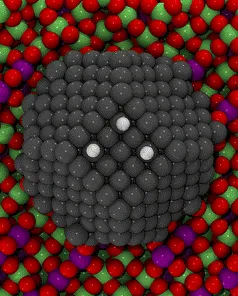
Ni Catalyst

Design and Analysis of Clay-swelling Inhibitors

The petroleum industry is significantly challenged by clay swelling in subterranean formations, which occurs when hydrophilic clays absorb water, expanding in size and reducing the permeability of oil- bearing reservoirs. This phenomenon results in decreased oil recovery efficiency, increased production costs, and the potential for severe operational disruptions. Inhibiting clay swelling is therefore critical to improving oil extraction, particularly in shale and other clay-rich formations.

Design of Porous Materials for Gas Storage and Separation

Hydrogen and methane storage is a critical challenge for realizing their potential as a clean energy carrier, especially in mobile and portable applications. Carbon-based porous materials such as activated carbons, graphene derivatives, and metal-organic frameworks (MOFs) have shown promise in their storage due to their high surface area, lightweight nature, and chemical stability.

Modelling of early stages of cloud formation

The climate change is a reality which is creating extreme weather patterns of heavy rains and droughts which leads to loss of lives. The immediate reason is formation or absence of clouds in these events and hence understanding their formation is necessary. In this project, the focus is to probe early stages of formation of clouds in atmosphere by water condensation. Effects of various parameters would be explored.

Simulation Study of Crude Oil Extraction by Chemical Flooding

Energy demand is increasing worldwide because of which extraction of crude-oil from existing matured oil-field is becoming more important. In mature oil fields, the crude-oil is strongly adhered to the rock surface. To remove this oil, additional chemicals needs to be supplied. In this project, we would use molecular simulations approach to probe the detachment of crude oil from rock surfaces using injecting fluids. This computational insight allows for the design of more efficient displacement fluids, bridging the gap between theoretical chemistry and field-scale production.

Multiscale Modelling of Non-Aqueous Electrolytes for Electrocatalysis

Electrocatalysis is central to decarbonising the chemical industry, from carbon dioxide reduction to green hydrogen production. Most computational tools in this area were developed for aqueous systems, but the field is now moving towards non-aqueous electrolytes such as ionic liquids and organic carbonates, which offer new reaction pathways and stability windows. Our group has recently implemented an implicit solvent model which interfaces with a density functional theory code.