Ongoing research in the Energy, Environment and Sustainability area, addresses non-fossil energy, industrial energy, climate and environment. In the area of energy, major research  topics under investigation are: Biomass and biofuels, Fuel cells, Solar thermal power, Process modeling and energy analysis and Combustion systems. In the area of biomass and biofuels, research addresses challenges at different scales. This includes work on improving biomass productivity through metabolic engineering, enhancing fuel production and selectivity through enzyme improvements, and achieving techno- economic feasibility through optimization approaches. In the area of fuel cells, research is aimed towards better selection of electrode materials by understanding processes that influence performance degradation. Work in the area of solar thermal power plants is focused in solving the challenging control problems in the domain. In industrial applications, work is mainly focused on industrial process modelling and energy integration as well as risk analysis. Research is also being carried out on in-situ coal gasification and biomass combustion under the theme of combustion systems.

In the broad and cross-cutting area of environment, which includes climate and sustainability, highly complex systems are being studied through phenomenological understanding and modeling of atmospheric constituents and transport, statistical methods for understanding and reducing uncertainty and complex systems-based modeling tools. The specific topics under investigation are: Climate, Sustainability, Water pollution, and Carbon capture systems.

Image
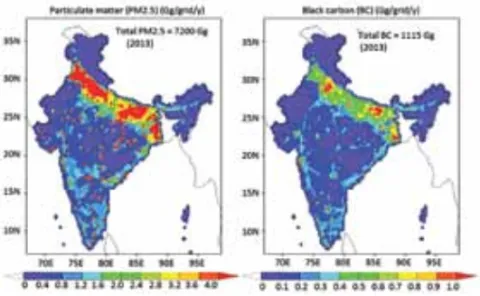
Spatial distributions of annual emissions of particulate matter (PM 2.5 ) and black carbon (BC) from Indian indus- trial, transport and residential energy-use

Optimization of carbon capture, sequestration and utilization for net-zero transition planning

The net-zero transition requires carbon capture followed by sequestration or utilization (also known as CCUS).  The transition must be carefully planned, considering the future carbon emission trends as well as the potential improvements in the capture, sequestration, and utilization technologies. Moreover, the net greenhouse gas reduction benefits will depend on the simultaneous changes in the energy production technologies (such as power plants) and the associated systems.

Bioenergy system design considering food-energy-water-climate nexus

Bioenergy options, such as ethanol, compressed biogas (CBG), and biopower, are expected to play an important role in the future energy mix, considering their potential to mitigate greenhouse gas emissions. However, biomass resources are limited and seasonally available. Moreover, the availability of biomass is increasingly impacted by climate change. Therefore, it is essential to plan a biomass utilization strategy for bioenergy, considering these complexities. The objective of this project would be to use an optimization framework to answer these questions.

Decarbonization through electrification

This project focusses on opportunities for decarbonization of chemical industry through electrification. Both direct and indirect electrification routes will be pursued. Specific objectives of the project include:

1. Analyze the impact of electrification on optimal design and operation of chemical systems.
2. Pursue electrification of conventional systems via direct/indirect modes.
3. Address optimal design and control challenge associated with electrification.

Sustainable power production through biogas

The project focusses on design, optimization and control of a renewable power production system. The system consists of three main components; biogas generation and cleanup, conversion of biogas into bio-hydrogen and lastly, converting this hydrogen into electricity using a fuel cell. These three components are strongly coupled in terms of material recycle and energy integration. The project objectives will be to:

Design and Analysis of Clay-swelling Inhibitors

The petroleum industry is significantly challenged by clay swelling in subterranean formations, which occurs when hydrophilic clays absorb water, expanding in size and reducing the permeability of oil- bearing reservoirs. This phenomenon results in decreased oil recovery efficiency, increased production costs, and the potential for severe operational disruptions. Inhibiting clay swelling is therefore critical to improving oil extraction, particularly in shale and other clay-rich formations.

Design of Porous Materials for Gas Storage and Separation

Hydrogen and methane storage is a critical challenge for realizing their potential as a clean energy carrier, especially in mobile and portable applications. Carbon-based porous materials such as activated carbons, graphene derivatives, and metal-organic frameworks (MOFs) have shown promise in their storage due to their high surface area, lightweight nature, and chemical stability.

Modelling of early stages of cloud formation

The climate change is a reality which is creating extreme weather patterns of heavy rains and droughts which leads to loss of lives. The immediate reason is formation or absence of clouds in these events and hence understanding their formation is necessary. In this project, the focus is to probe early stages of formation of clouds in atmosphere by water condensation. Effects of various parameters would be explored.

Simulation Study of Crude Oil Extraction by Chemical Flooding

Energy demand is increasing worldwide because of which extraction of crude-oil from existing matured oil-field is becoming more important. In mature oil fields, the crude-oil is strongly adhered to the rock surface. To remove this oil, additional chemicals needs to be supplied. In this project, we would use molecular simulations approach to probe the detachment of crude oil from rock surfaces using injecting fluids. This computational insight allows for the design of more efficient displacement fluids, bridging the gap between theoretical chemistry and field-scale production.

Gravity-driven device for removal of microorganisms, metals and microplastics from water

We have already developed a working prototype for killing and removal of
E. coli from water. It is based on our synthesized nanocomposite, made
of Ag-Cu nanoparticle impregnated on granular activated carbon and
packed into a filter column, which is driven by gravity-head of the water

Chemical sensor device development for detection of water pollutants and technology for their removal

We have already developed in our lab. an autonomous device for
real-time, water quality monitoring by both physical and chemical
sensors (some of the sensors being developed by us), with years of
earllier work in our lab. by a multidisciplinary team of Chemical, Mechanical and Electrical Engg. students.