
Overview
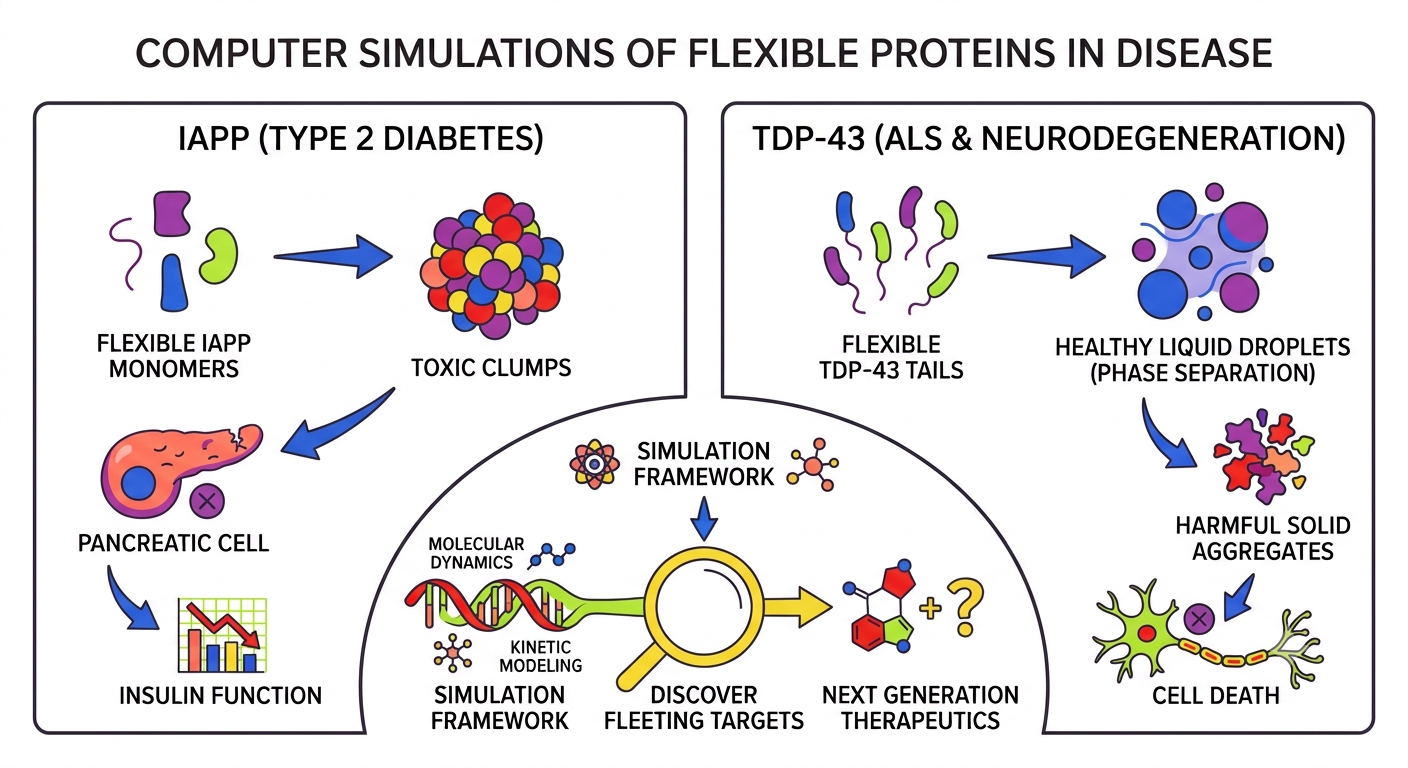
Most proteins fold into a rigid shape to do their job. However, a fascinating class called Intrinsically Disordered Proteins (IDPs) are completely flexible and shape-shifting. Because they lack a fixed structure, they are essential for controlling key cellular processes. But this same flexibility can also backfire—when these proteins misfold, they can clump together and cause severe human diseases.
In this project, we use computer simulations (Molecular Dynamics) to watch these flexible proteins in motion at atomic detail, identifying hidden "switches" in their structure to help guide future drug discovery.
The Disease Targets:
1. IAPP (Islet Amyloid Polypeptide)
Role in Metabolic Disease: Secreted alongside insulin by pancreatic  -cells, IAPP normally helps regulate blood glucose levels. In Type 2 Diabetes, IAPP misfolds and aggregates into toxic clumps, directly destroying the insulin-producing cells of the pancreas. Simulations will map the exact step-by-step conformational shifts that lead IAPP to form early toxic intermediates, identifying transient structural "switches" that can be targeted by stabilizing drug molecules.
2. TDP-43 C-Terminal Domain
Role in Neurodegeneration : TDP-43 regulates gene expression in neurons. Its long, flexible C-terminal tail allows it to form functional liquid-like droplets inside the cell via liquid–liquid phase separation. In Amyotrophic Lateral Sclerosis (ALS) and Frontotemporal Dementia (FTD), disease-linked mutations cause these liquid droplets to solidify into permanent, toxic protein inclusions that kill motor neurons. Simulations will reveal how ALS-associated mutations alter the local flexibility and sidechain contacts of the C-terminal tail, capturing the exact transition from a dynamic liquid condensate state to a rigid, harmful aggregate.
Why IDPs Matter ?
For decades, drugs were designed to fit into rigid protein pockets like a key into a lock. Because IDPs have no fixed pocket, they were thought to be "undruggable." Simulations help us find temporary, fleeting targets for new medicines. In addition, misfolding of flexible proteins is at the root of major metabolic and neurodegenerative conditions, including Diabetes, ALS, Parkinson's, and Alzheimer's.
What You Will Learn & Experience
- Run Computer Simulations: Learn how to set up, run, and analyze all-atom Molecular Dynamics (MD) simulations on high-performance supercomputers.
- Data Analysis & Visualization: Turn gigabytes of raw simulation data into molecular movies, contact maps, and conformational landscapes.
- Modern Computational Biophysics: Experience how basic physics and computer science are used together to solve real biomedical problems.
Prerequisites
- Programming: Basic familiarity with Python or C/C++ (or a willingness to learn!).
- Core Background: High school (Grades XI–XII) and foundational undergraduate-level mathematics mandatory.
- Curiosity: Enthusiasm for biophysics, computing, and structural biology—no prior simulation experience required!
About Our Lab & Expertise
Our group works at the intersection of biophysics, computer modeling, and theoretical chemistry. While we routinely use standard Molecular Dynamics, our lab also develops custom computational tools to push simulations to longer timescales.
Our Research Focus & Innovations:
- Advanced Kinetic Modeling: We build mathematical models (Markov State Models) to map out how proteins transition between different shapes over time.
- Smart Sampling Methods: We develop enhanced simulation techniques to help computers capture rare, long-timescale protein movements much faster than traditional methods. Key innovations from our lab include Time dependent Markov State Models, Adaptive State Constrained MD (for automated construction of MSMs).
- Quantifying Protein Disorder: We create unique metrics to measure and characterize structural flexibility in disordered proteins.
Sub Areas
- Computational Biology