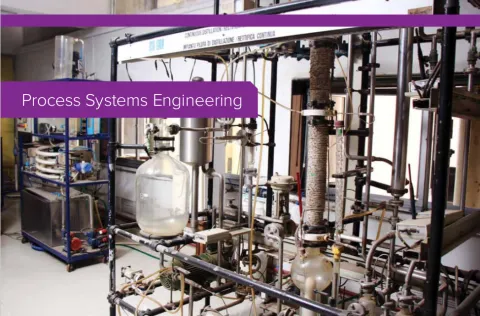
Process Systems Engineering (PSE) focuses on a complete, life cycle view of the manufacturing process in chemical engineering, beginning from the scale of molecule discovery &  scale up to the other end of spectrum relating to achieving manufacturing excellence and minimizing environmental impact. The PSE research has been focusing on these various individual steps in the life cycle of process engineering from both theoretical as well application perspectives. Beginning at the smallest scale of molecular modeling, research work at the  department has focused on Novel multi-scale simulation techniques for simulating complex interacting systems.The molecular scale information is employed with macroscopic models to describe chemical processes at the device length scales. Attempts to exploit the predictive capabilities of these multi-scale models for optimizing aforementioned devices are also currently underway. At the larger scale, the group has been focusing on the development of a generalized reactor model framework that can accommodate the wide diversity of chemical reactors. Establishing empirical cause and effect relationships for the purposes of process development, scale-up, process optimization, advanced process control, as well as fault detection and diagnosis, has been an area of significant activity in the systems engineering group. Basic and advanced optimization has been a focus area of research in the  department with several important and critical applications. Optimization for sensor network design that balances different criteria, such as process observability, precision & accuracy of parameter estimates and fault isolability, and overall cost of the sensor network has been an another active research area of the group. The group also focuses on the design of energy efficient heat exchanger networks along with approaches to identify opportunities for process intensification, i.e evolving substantially smaller, cleaner, and more energy-efficient designs. Some of key applications that are being considered are design of novel reactive separations methods for important industrial systems and design of new and alternate process routes  related to green manufacturing. Basic and advanced process control approaches are deployed in chemical process manufacturing to realize the optimal targets resulting from design and/or operational optimization steps. Model predictive control (MPC) has been one of the popular model based control algorithms. The group works on multi-parametric MPC approach with special  applications to fast transient systems. Biological systems exhibit several interesting phenomena at the cell level such as significantly amplified sensitivity of enzyme cascades. To develop a better understanding of these interesting phenomena, control theoretic approaches have been successfully used to represent and explain the feedback-like structures at the cell level.

Image
Process systems and control research group

Bioenergy system design considering food-energy-water-climate nexus

Bioenergy options, such as ethanol, compressed biogas (CBG), and biopower, are expected to play an important role in the future energy mix, considering their potential to mitigate greenhouse gas emissions. However, biomass resources are limited and seasonally available. Moreover, the availability of biomass is increasingly impacted by climate change. Therefore, it is essential to plan a biomass utilization strategy for bioenergy, considering these complexities. The objective of this project would be to use an optimization framework to answer these questions.

Distributed control of interacting systems

Distributed control has emerged as an effective strategy to achieve optimal control of large scale interacting networks. This project focusses on the following objectives:

1. Develop graph-theoretical contributions for synthesizing distributed architectures for advanced control
2. Validate the architectures via dynamic simulations
3. Experimentally verify and validate the theoretical contributions on benchmark systems like quadruple tank system.

Decarbonization through electrification

This project focusses on opportunities for decarbonization of chemical industry through electrification. Both direct and indirect electrification routes will be pursued. Specific objectives of the project include:

1. Analyze the impact of electrification on optimal design and operation of chemical systems.
2. Pursue electrification of conventional systems via direct/indirect modes.
3. Address optimal design and control challenge associated with electrification.

Sustainable power production through biogas

The project focusses on design, optimization and control of a renewable power production system. The system consists of three main components; biogas generation and cleanup, conversion of biogas into bio-hydrogen and lastly, converting this hydrogen into electricity using a fuel cell. These three components are strongly coupled in terms of material recycle and energy integration. The project objectives will be to:

Foundational Model to Aid Process Design Activity

Co-supervisor: Sujit S Jogwar

The work will look at approaches which can harness foundational models to help with piping and instrumentation diagram creation. This is part of an ongoing activity with invovlement of a design engineering company. Beyond using foundational existing models, the work will also explore ways to efficiently update (finetune) existing models using documents/data from the engineering company or otherwise available in literature. Currently there are no such available tools.