
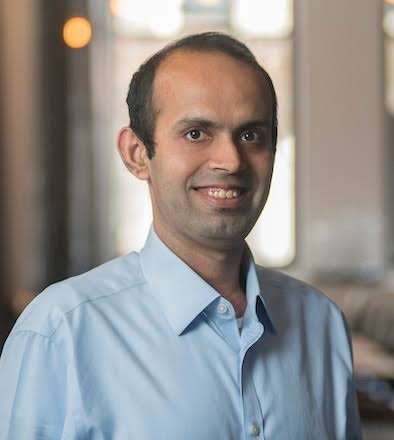
Speaker Name: Prof. Manas Rachh, Associate Professor, Department of Mathematics, IIT Bombay
Date: 30-09-2026 (Wednesday)
Time: 14:30
Venue: LC001
Abstract: A number of multi-scale phenomena are modeled by coupled bulk-surface partial differential equation systems. For example, flexural-gravity models for ice floes couple bending forces in the ice to fluid flow in the sea, resulting in a Laplace equation in the half-space with a fourth order surface differential equation as a boundary condition on $z=0$. A collection of similar problems can be found in the literature, where the boundary effects include flexural, elastic, viscous, thermal, or surface tension effects, and the bulk equations include potential flow and acoustic wave equations. In the case of the half space, there is a particularly effective numerical approach for this class of problems characterized by the use of a nested integral representation for the solution. We will present the main ideas behind the representations and an acceleration scheme for the associated Green's functions, which do not satisfy a PDE on surface. This is joint work with Peter Nekrasov (Flatiron Institute), Tristan Goodwill (U. Chicago), Jeremy Hoskins (U. Chicago), and Travis Askham (NJIT).
Bio: Manas Rachh is currently an Associate Professor in the Mathematics Department at IIT Bombay. Before coming to IIT, he was a research scientist in the Center for Computational Mathematics at the Flatiron Institute, and prior to that he was a Gibbs Assistant Professor in Applied Mathematics at Yale University. Manas' research interests include partial differential equations (PDEs) arising in mathematical physics, integral equation methods, robust computation of eigenvalues and eigenfunctions of elliptic PDEs, and the development of fast algorithms for applications in electrostatics, acoustics, viscous flow, electromagnetics, biomedical imaging, and data visualization. He obtained his B.Tech and M.Tech in Aerospace Engineering from the Indian Institute of Technology Bombay in 2011, and his Ph.D. from the Courant Institute of Mathematical Sciences at New York University in 2015.